Infographic
Text & sources
An editorial synthesis of Sebastian Marshall’s Roguelike (2015). The illustrations are newly generated, not original book graphics. Source references use added chapter and paragraph locators because the supplied EPUB has no reliable printed page numbers.
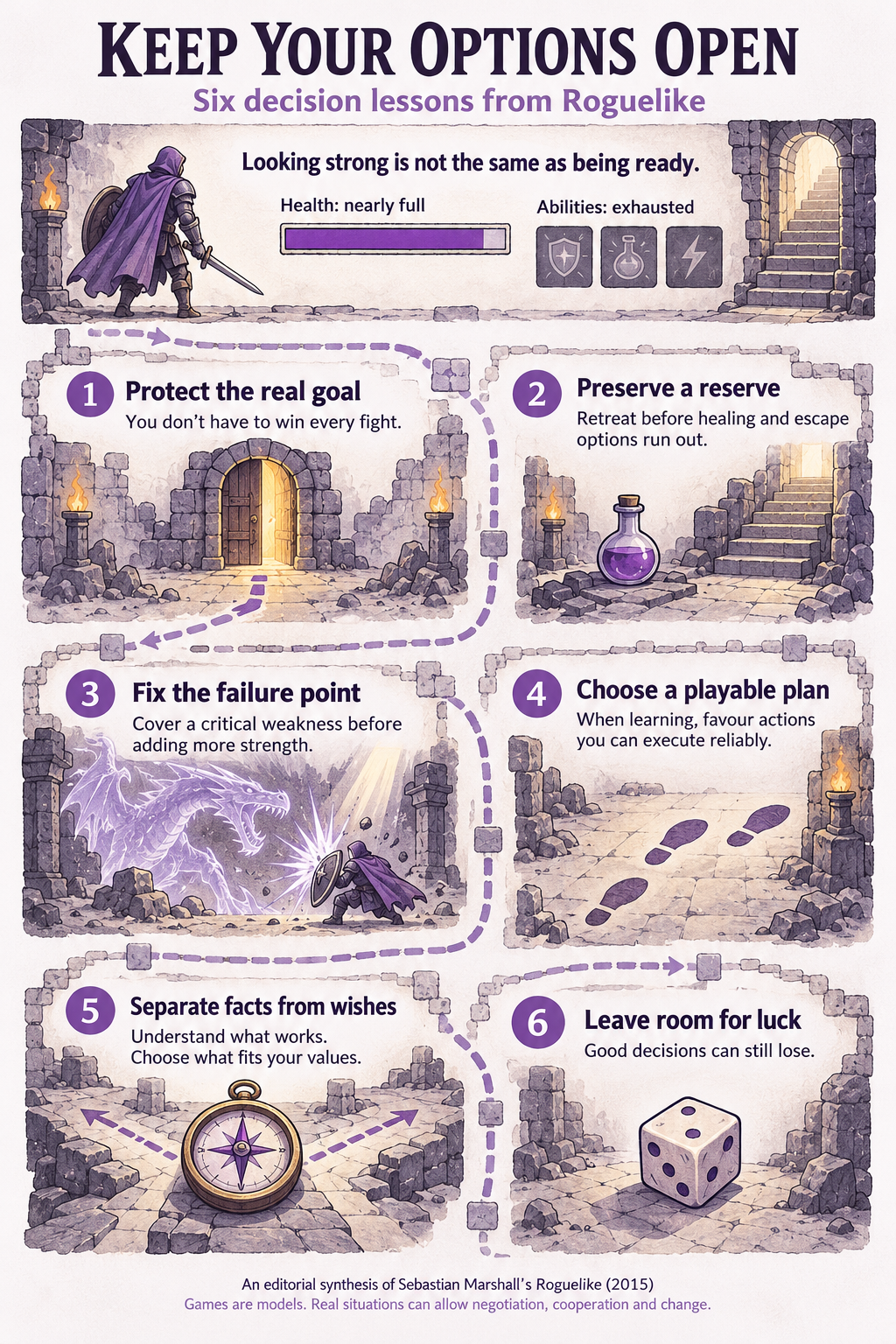
Looking strong is not the same as being ready.
In Marshall’s constructed berserker scenario, nearly full health conceals exhausted abilities. A nearby staircase offers a chance to retreat and recover. The bars are conceptual illustrations, not measured data.
Sources
- 3. Staying Out of Messes in the First Place15–33
1. Protect the real goal
You don’t have to win every fight.
Marshall distinguishes completing the game from defeating every optional enemy. In life, deciding which objective matters is itself a choice.
2. Preserve a reserve
Retreat before healing and escape options run out.
The proposed retreat trigger depends on the danger of withdrawal; this is not a rule to flee every difficult situation.
Sources
- 3 Defensive Policies9–19
3. Fix the failure point
Cover a critical weakness before adding more strength.
The hypothetical ghost dragon resists the critical-hit mechanism on which the character’s equipment depends. A modest alternative attack can help more than further specialization, although it does not guarantee survival.
Sources
- 7. Constructing One's Build, V: Diminishing Returns, Weaknesses, and Whither Flame Mastery?30–63
4. Choose a playable plan
When learning, favour actions you can execute reliably.
Marshall recommends simpler ways to play while inexperienced; greater skill can make complex abilities preferable.
Sources
- 5 Piloting I: Skill Required…1–20
5. Separate facts from wishes
Understand what works. Choose what fits your values.
Understanding an incentive does not oblige you to pursue it. Marshall allows ethical refusal, accepting a cost, changing environments and choosing a different goal.
Sources
- 10 (That’s Not To Say It’s Easy)8–20
6. Leave room for luck
Good decisions can still lose.
Marshall explicitly acknowledges that even excellent play cannot guarantee success. Outcomes alone are an incomplete test of decision quality.
Sources
- 1. Will Perfect Play Win You the Game?1–31
Games are models. Real situations can allow negotiation, cooperation and changing the rules; the book offers analogies and personal observations, not a demonstrated law of human performance.
Creation record
| Generation | Built-in imagegen · 1 completed job · 0 failures · 0 retries |
|---|---|
| Measured elapsed time | 37.038 seconds, from tool dispatch to completed result. Includes service and transfer time. |
| Processing time | Separate render/GPU processing time and phase times were not exposed. |
| Output | 1024 × 1536 PNG · 3,164,299 bytes (3.02 MiB) |
| Resolution | Native delivered resolution; no additional resizing or upscaling. Internal model stages undisclosed. |
| Model and settings | Built-in tool did not expose model/version, quantization, adapters/strengths, seed, steps, sampler, scheduler, guidance, denoise or GPU/worker. |
| Resources | Peak VRAM and energy were not recorded. |
| Timeline and audio | Static image. Duration, frame rate/count and audio are not applicable. |